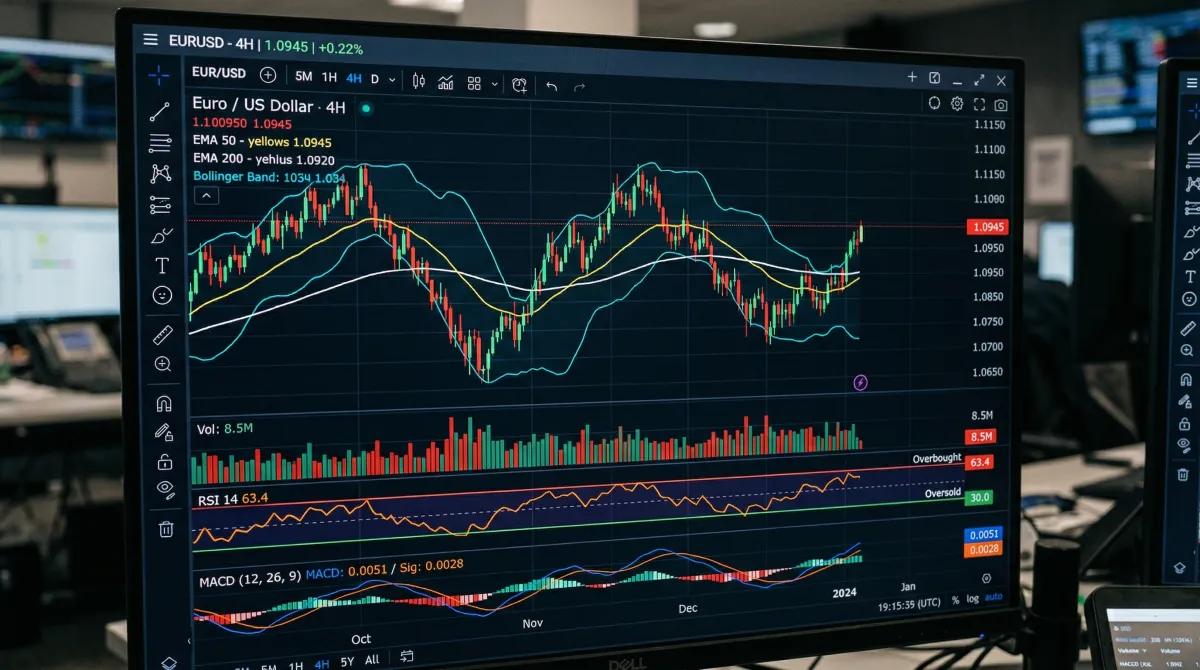
What is technical analysis in trading?
Technical analysis is an approach used by traders to study and interpret the price evolution of a financial asset based on historical charts. It is based on the observation of past market movements in order to anticipate, with a certain probability, future movements.
In contrast to an analysis based on the intrinsic value of an asset, technical analysis focuses exclusively on price behavior and market data such as volume. The central idea is that price already reflects all available information, and that market dynamics tend to repeat themselves over time.
Thus, technical analysis can be seen as a reading of the interactions between supply and demand, visible directly through price variations on a chart.
This approach is applicable to a wide variety of financial markets:
Forex (currency pairs)
Commodities
Stock market indices
Cryptocurrencies
Bonds
Technical analysis vs. fundamental analysis
When we speak of technical analysis, we refer to the visual and statistical study of prices and volumes on a chart. The aim is to identify patterns, trends and key areas for making trading decisions.
In contrast, fundamental analysis relies on macroeconomic or financial elements such as:
Interest rates
Inflation
Economic data (employment, GDP, etc..)
Geopolitical events
Technical traders favor a variety of time horizons, ranging from the very short term (scalping) to the medium term, based on indicators and market structures.
Many traders choose to combine the two approaches to obtain a more complete view of the market. This combination provides a better understanding of the overall context, while refining entry and exit points through technical analysis.
For example, certain correlations between commodities and currencies can be exploited. A country heavily dependent on oil exports will often see its currency influenced by variations in the price per barrel. A significant drop in oil prices can therefore lead to downward pressure on its currency.
A case in point was observed during the collapse of the oil markets in 2020, when certain currencies linked to energy resources experienced high volatility. Similarly, during the global health crisis, a massive drop in demand led to historic imbalances between supply and demand, even reaching unprecedented situations on certain oil contracts.
The first steps in technical analysis
Before even taking a position on a market, a technical analyst begins by observing the chart as a whole, usually focusing on high time units (daily, weekly).
The aim is to identify:
The general trend (bullish, bearish or sideways)
Support and resistance zones
The overall structure of the market
These elements provide a better understanding of the context in which the price is evolving before looking for more precise opportunities.
Understanding support and resistance zones
Support zones correspond to price levels where demand has historically been strong enough to prevent the price from falling further.
Inversely, resistance zones represent levels where supply is becoming dominant, curbing price rises.
The more a level is tested and respected over time, the more significant it becomes. These zones can extend over long periods, sometimes several months or years, and remain relevant even for short-term trades.
Analyzing these zones is essential, as markets tend to react to levels already identified in the past.
Tools used in technical analysis
Technical traders rely on various tools to refine their analysis, including:
Moving averages, to identify the trend
Momentum indicators, to measure the strength of the movement
Oscillators, to spot overbought and oversold areas
Graphical tools, such as trend lines, channels or chartist figures
These tools are not used in isolation, but combined to reinforce the quality of decisions and increase the probability of successful trades.
Identifying entry and exit points
Once key areas have been identified, the trader looks for optimal entry opportunities.
A common strategy is to buy on pullbacks in an uptrend or sell on rebounds in a downtrend.
However, entering a support or resistance level too early can expose false signals. For example, a market can form set-ups such as:
Double top
Double bottom
In these cases, the price may move slightly above a key level before moving back in the opposite direction, trapping traders who are too early.
This is why experienced traders often wait for confirmation before positioning themselves, such as a validated breakout or a return to a key level after breakout.
The role of confirmation in trading
A common mistake among beginners is to anticipate reversals without market validation.
For example, a trader may want to buy after a dip (Buy the Dip), but without confirmation of a reversal, the price may continue to fall before heading back up.
Markets tend to manipulate liquidity zones, triggering stop-losses before reversing their actual direction. This phenomenon is particularly noticeable around major peaks and troughs.
Waiting for confirmation reduces risk and improves the quality of position-taking.
Conclusion
Technical analysis is a powerful tool that enables traders to read the market through its historical data. By combining the study of trends, key areas and indicators, it offers a structured approach to identifying trading opportunities.
Although it can be used on its own, its effectiveness is often enhanced when combined with fundamental analysis, particularly for medium- and long-term strategies.
Mastery of technical analysis is based on practice, observation and understanding of price behavior in different market contexts.
To go further: https://www.youtube.com/watch?v=JNa4AIb7B2s&t=4s
🎬 Pour aller plus loin
Si tu veux approfondir ce sujet et progresser en trading, retrouve nos vidéos éducatives gratuites sur La Trading School 🎥