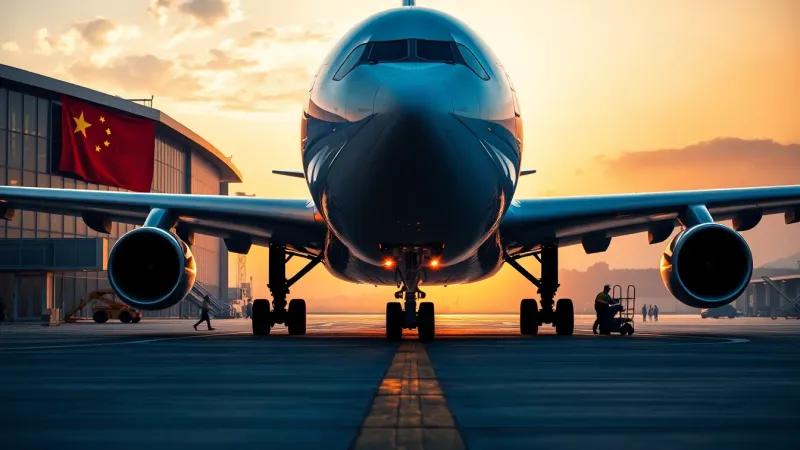
Boeing has just secured key access to the Chinese market. According to one of its executives, the American aircraft manufacturer will be able to provide after-sales service for an order of 200 aircraft destined for China. Against the backdrop of U.S.-China trade tensions, this is a strong card to play. ✈️
🔍 What’s happening?
A Boeing official confirmed that the company has been authorized to provide after-sales technical and logistical support for this massive order of 200 jets. This green light comes at a time when Sino-American relations remain tense, and Beijing could easily block this type of access.
For Boeing, this is much more than just a sale of aircraft. The after-sales service market represents billions of dollars over the lifespan of a fleet. Spare parts, maintenance, ground crew training: all of this translates to recurring revenue over 20 to 30 years.
💡 Why does this matter?
China is the world’s second-largest market for civil aviation, just behind the United States. Without access to after-sales support, a jet order loses half its strategic value. Boeing is therefore securing a long-term revenue stream against its competitor Airbus, which also has its eye on this massive market.
On the geopolitical front, this announcement shows that despite tensions (trade war, tech sanctions, tit-for-tat retaliation), certain industrial projects are still moving forward. China needs to modernize its air fleet to support its domestic growth. Boeing needs China to balance its order books following the setbacks with the 737 MAX.
📊 Our view
For us, this is a positive signal for Boeing stock, but we must remain realistic. This green light could be revoked overnight if geopolitical tensions escalate further.
The real gamble here is that Beijing will play the card of economic pragmatism rather than that of escalation. China needs modern aircraft for its domestic airlines. Boeing needs cash and volume to recoup its R&D investments. Both sides have an interest in cooperating, even if Trump or a future U.S. president decides to tighten the screws on semiconductors or AI. Civil aviation remains a sector where interdependencies are too strong for a complete breakdown. On the European side, Airbus is following this issue very closely: every Boeing order that goes through means an Airbus order is lost.
We anticipate Boeing consolidating in the $180–$190 range if no geopolitical hiccups throw a wrench in the works. For French traders: keep an eye on announcements from the U.S. Department of Commerce and statements from the Chinese government. A shift in tone could turn the situation around in 48 hours.
✅ Key takeaway
- Boeing may provide after-sales service for 200 jets sold to China
- The aftermarket represents billions over 20-30 years
- Signs of a partial easing in US-China tensions
- Airbus is closely monitoring every order it loses
- The green light could be revoked if geopolitical tensions escalate
What do you think? Is Boeing still a good long-term bet despite geopolitical risks, or would you rather invest in Airbus to avoid exposure to the US-China situation?
🔎 See also
To learn more, check out all our stock analyses on ActuTrading Stocks 📈
Source: Boeing press release, Investing.com