Trump Hits Indian Pharma Sector: Sharp Drop in Mumbai
Donald Trump is targeting Indian generic drugs. Pharmaceutical stocks in Mumbai plummeted following the announcement of new U.S. tariffs.
France's #1 big pharma, ~€140B market cap, Sanofi dominated by Dupixent blockbuster (~€14B revenue) and vaccines/diabetes portfolio. Solid 4% dividend, moderate valuation but growth slowed by competition.
Sanofi is the world's #9 big pharma by revenue (~€45B in 2024) behind Pfizer, J&J, Roche, Novartis, Merck, AstraZeneca, AbbVie, Eli Lilly. No longer top 5 like in 2000s-2010s (industry polarized toward US biotech and Eli Lilly/Novo Nordisk GLP-1 boom).
4 strategic pillars:
1. Specialties (Pharmaceuticals, 60 % of revenue) - Dupixent (dupilumab): THE blockbuster. Anti-inflammatory for eczema, asthma, nasal polyposis, COPD, EoE. 2024 revenue: ~€14B, 2026 estimated: €17-18B. Patent until 2030. Co-developed with Regeneron (50/50 on profits). - Aubagio, Lemtrada (multiple sclerosis): declining - Hemophilia: Eloctate, Alprolix - Oncology: Sarclisa (multiple myeloma), modest pipeline
2. Vaccines (15 %) - World's #2 vaccine maker after Pfizer (but missed Covid mRNA boom) - Flu vaccine: Vaxigrip, Fluzone - RSV vaccine (baby): Beyfortus growing strongly - Polio, meningitis, pediatric vaccines - No proprietary mRNA (abandoned), Translate Bio partnership but few results
3. General Medicines (20 %) - Insulins (Lantus, Toujeo, Apidra): declining under GLP-1 pressure (Ozempic, Mounjaro reducing insulin need) — estimated loss €1-2B/year - Plavix (anticoagulant): generic everywhere - Lovenox (injectable anticoagulant)
4. Consumer Healthcare (5 %, being separated) - Doliprane (France's #1 paracetamol) - Maalox, Allegra, Aspirin - Sanofi announced October 2024 selling 50 % of Consumer to CD&R fund for ~€16B (deal ongoing, completion 2025-2026). Strategy: refocus on pharma innovation.
CEO: Paul Hudson (since 2019, British, ex-Novartis). Mission: revitalize pipeline and make Sanofi a "Dupixent + Vaccines + R&D pipeline". Analysts criticize him for not finding new blockbuster in 6 years.
Dupixent represents 30 % of revenue and 50 % of growth for Sanofi. It's both its strength and fragility.
Dupixent advantage: - Patent until 2030 (then biosimilars) - Continuous indication extensions: eczema, asthma, COPD, EoE, polyposis, prurigo. Each new indication adds €1-3B potential revenue. - Undisputed leader position in Th2 inflammation - Revenue can reach €20-22B around 2028-2029
Dupixent risk: - Patent cliff in 2030: -30 to -50 % revenue in 2 years upon biosimilar arrival - Emerging competition: new anti-inflammation approaches (TSLP, IL-13 monotherapy) at Amgen, Roche, AstraZeneca - Sanofi shares 50 % with Regeneron: half Dupixent profits go to NY, not Paris
The pipeline problem: Sanofi has relatively few relay blockbusters. Hopes rest on: 1. Frexalimab (multiple sclerosis): phase 3 ongoing, potential launch 2027-2028. Potential market ~$5B if success, but failure risk. 2. Tolebrutinib (progressive MS): uncertain phase 3, $2-3B potential 3. Itepekimab (COPD, asthma): Sanofi+Regeneron pipe, $5-7B potential if success 4. Adult RSV vaccines: 2025-2026 commercialization
Recent acquisitions: - Provention Bio (2023, $2.9B): Tzield for type 1 diabetes — disappointing so far - Inhibrx (2024, $1.7B): INBRX-101 for alpha-1 antitrypsin deficiency — niche - Vigil Neuroscience (2024, $470M): Alzheimer, very early
Stock price evolution: - Peak at €107 in March 2024 - Drop to €84 in November 2024 following Consumer split announcement + pipeline disappointment - Current price (April 2026): ~€98 - Forward 2026 PE: 12 (vs 18 for Roche, 22 for Novo Nordisk, 30 for Eli Lilly)
Sanofi is one of cheapest big pharma on market. Either market is right (weak pipeline, GLP-1 threatens insulin, 2030 Dupixent cliff), or it's a value opportunity.
Bull case (buy): 1. Very low valuation: 12 PE vs pharma avg 18 — 30 % discount 2. Solid dividend: €4/share, 4 % yield, regular growth 3. Dupixent still growing until 2030 (+10-15 %/year) 4. Consumer divestment = €8B cash: usable for buybacks or acquisitions 5. Solid balance sheet: net debt/EBITDA = 1.5x, A+ 6. Vaccines growing: Beyfortus (RSV baby) exploding, +€500M/year
Bear case (avoid): 1. No visible Dupixent relay: 2030 cliff concerning 2. Falling insulins: GLP-1 pressure removes €1-2B revenue/year 3. Disappointing R&D pipeline: no identified blockbuster outside Dupixent 4. US biotech competition: Eli Lilly (+150 % in 2 years) crushes European pharma 5. Legal risks: Zantac litigation (cancers linked to ranitidine), €1-3B fine risk
How to invest Sanofi:
1. Direct stock on Euronext Paris - Code: SAN (Euronext) or SNY (NYSE ADR) - 1 share = ~€98 - PEA-eligible: yes, tax exemption after 5 years - Dividend: paid in May (1 time/year), late-April ex-date
2. Health / pharma ETF - Lyxor MSCI World Health Care (HLTW): Sanofi ~3 %, J&J, Eli Lilly, Pfizer, Roche - iShares Health Care (HEAL): equivalent - Diversification but losing French pure play
3. World / Europe ETF - Sanofi ~0.5-1 % of an MSCI Europe
Comparison with peers: - Sanofi vs Novartis: Novartis more diversified, better pipeline (Cosentyx, Entresto), 18 PE. Sanofi cheaper but riskier. - Sanofi vs AstraZeneca: AZ better oncology pipeline (Tagrisso, Imfinzi), 17 PE. Sanofi more defensive via vaccines. - Sanofi vs Eli Lilly: Lilly = GLP-1 + Alzheimer (donanemab) star, 30 PE. Sanofi not in same race but less risky and better dividend.
Strategies: - Dividend play: buy for 4 % yield in PEA, wait for market to recognize value - Frexalimab catalyst: buy before phase 3 MS results late 2025/2026 — if positive, +20-30 % in 1 day - Consumer divestment: if deal finalizes > €16B, exceptional dividend or massive buyback possible
My reco: Opportunistic PEA buy if < €90 for yield and discount. Not pure growth stock, but value defensive to balance French portfolio otherwise too luxury-tilted (LVMH, L'Oréal). Allocation 3-5 % of PEA. Watch: frexalimab phase 3 announcements and Consumer split finalization.

Donald Trump is targeting Indian generic drugs. Pharmaceutical stocks in Mumbai plummeted following the announcement of new U.S. tariffs.

TotalEnergies shares are down after the company reported second-quarter results that were weaker than those of its British competitors. The European oil sector is showing mixed performance.

The U.S. president says the ceasefire with Iran is on life support. European stock markets are expected to open sharply lower on Tuesday.

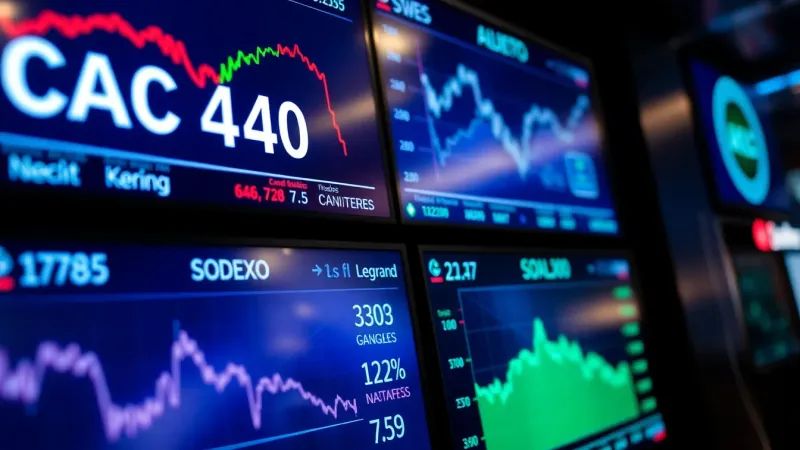
CAC 40 futures are down 60 points to 8,110 points this Friday morning. The U.S. jobs report and tensions surrounding the Iran-U.S. ceasefire are weighing on the market at the open.

The British pharmaceutical company's stock fell 2% following the U.S. advisory committee's negative vote on camizestrant, a key drug expected to generate $5 billion in sales.

The French luxury giant's share price plummets after disappointing Q1 sales. War and currency effects cost the group 290 million euros.

The CAC 40 gained ground on Tuesday morning on the back of easing geopolitical tensions. But LVMH disappointed with sales down 6%.

The week kicks off with analysts' opinions on several CAC 40 stocks. Kering, Legrand and Sodexo are at the heart of this week's recommendation adjustments.

Paris, London and Frankfurt fell back at the start of the session. The failure of negotiations between Washington and Teheran has triggered a wave of risk aversion on the Old Continent.

European markets tumbled on Monday morning. Paris lost 0.94%, Frankfurt 0.96%, London 0.56%. Cause: tensions between Iran and the United States over a threatened port blockade.

The Q1 2026 results season begins on Monday with LVMH. Ten companies will publish on April 23. Get ready to follow the real performance of the French market.

An agreement between Iran and the United States boosts the French economy. OFCE forecasts growth of 0.8% in 2026 if energy prices return to normal.

European stock markets are back on the rise following the signing of a 15-day ceasefire between the United States and Iran, agreed just before Trump's ultimatum.

the year's sector rotation is underway